Programmatic SEO in Production: How We Scaled miseguro.com.ar with AI, Data, and Architecture
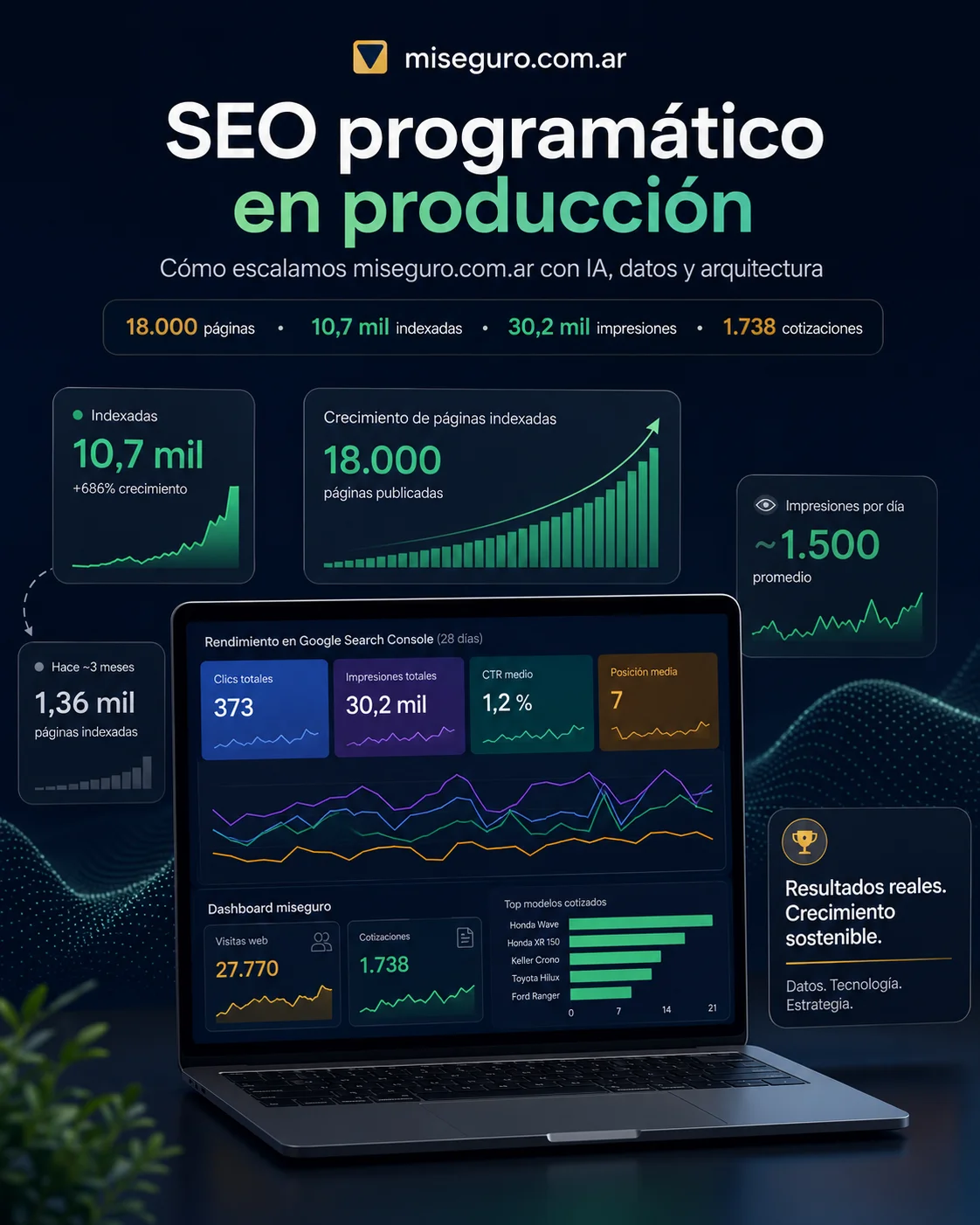
A real-world case study of a site that went from initial validation to thousands of pages, 18,000 published, 10,700 indexed, delivering over 30,200 impressions, 373 clicks, a 1.2% CTR, and 1,738 quotes in just 28 days.
July 14, 2026
There are a thousand ways to talk about programmatic SEO. Most stay in the realm of theory: generate lots of pages, automate templates, scale content, and cover long-tail queries.
We prefer to talk about what happens when that approach hits production for real. Because one thing is saying “We do programmatic SEO,” and something entirely different is building a system that detects opportunities, generates useful pages, gets indexed, earns impressions, drives traffic, and ultimately converts into real quotes.
That’s exactly what happened with miseguro.com.ar. In roughly three months, the project went from an initial validation phase to a full-blown growth engine, with measurable results:
- 18,000 pages published
- 10,700 pages indexed by Google
- 30,200 impressions in 28 days
- 373 clicks from Search Console
- Average CTR of 1.2%
- Average position 7
- ~1,500 impressions per day
- 27,770 website visits
- 1,738 quotes generated
And here’s the kicker: none of this happened by “throwing thousands of URLs into the air.” It was the result of combining solid architecture, real data, commercial intent, and a multi-agent AI pipeline.
The Biggest Mistake in Programmatic SEO
When people hear “programmatic SEO,” they often picture a simple formula: take several dimensions, combine them, generate thousands of pages, and wait for traffic.
In practice, that poorly executed approach produces exactly what you don’t want: duplicate intent pages, worthless clusters, thin content, spotty indexing, and an expansion that doesn’t translate into real business impact.
Volume alone isn’t enough. 18,000 pages don’t equal 18,000 opportunities. That’s probably the biggest mistake people make when trying to scale organic traffic automatically.
At miseguro.com.ar, we didn’t work with a “create everything possible” mindset. We worked with a “prioritize what makes sense” mindset. That means treating every combination not as a potential URL, but as a business question: Is there real intent? Is there a specific need behind that search? Can this page stand out? Do we have solid data to back it up? Can this combination lead to a quote, or are we just creating noise?
The difference between a system that grows and one that self-destructs lies right there.
Why Insurance is Perfect for Programmatic SEO
The insurance world, especially auto and motorcycle, has something incredibly valuable for this kind of strategy: natural, repeatable dimensions. Vehicle type, make, model, city or province, search intent, commercial need, price, coverage, issuance capability.
This creates a massive number of possible searches, but not all are equally valuable. Some are informational, others are comparative, and some have crystal-clear transactional intent. And that’s where programmatic SEO stops being just “publishing pages” and becomes a true acquisition system.
At miseguro.com.ar, expansion wasn’t just about SEO. It was about aligning what people search for, what we can solve, what we can get indexed, and what can actually convert.
From Validation to Scalable Architecture
The project started just over three months ago. The first step? Validating whether there was a real opportunity to grow organically in this vertical. That initial phase already showed clear signals.
Then came the hard part: scaling. That’s where three things came together: an architecture built to handle thousands of URLs, real data justifying the existence of each page, and an AI pipeline helping to discover, analyze, prioritize, generate, and improve.
The result was strong site expansion, one that today clearly differentiates between “having content” and running a genuine organic growth system.
The Numbers That Matter
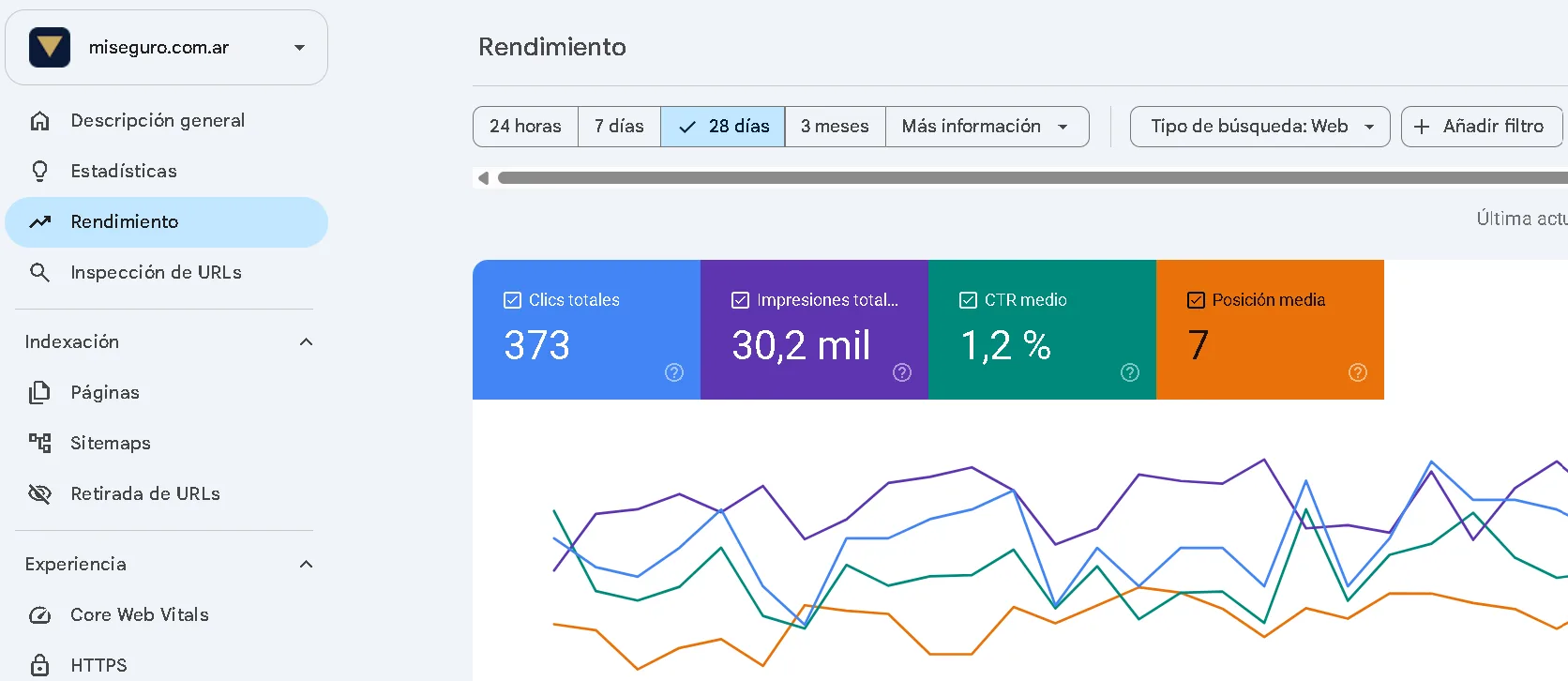
In Search Console over the last 28 days, the site delivered 30,200 impressions, 373 clicks, a 1.2% CTR, and an average position of 7. Google has already indexed 10,700 pages, and from our internal dashboard, the commercial impact is clear: 27,770 website visits and 1,738 quotes.
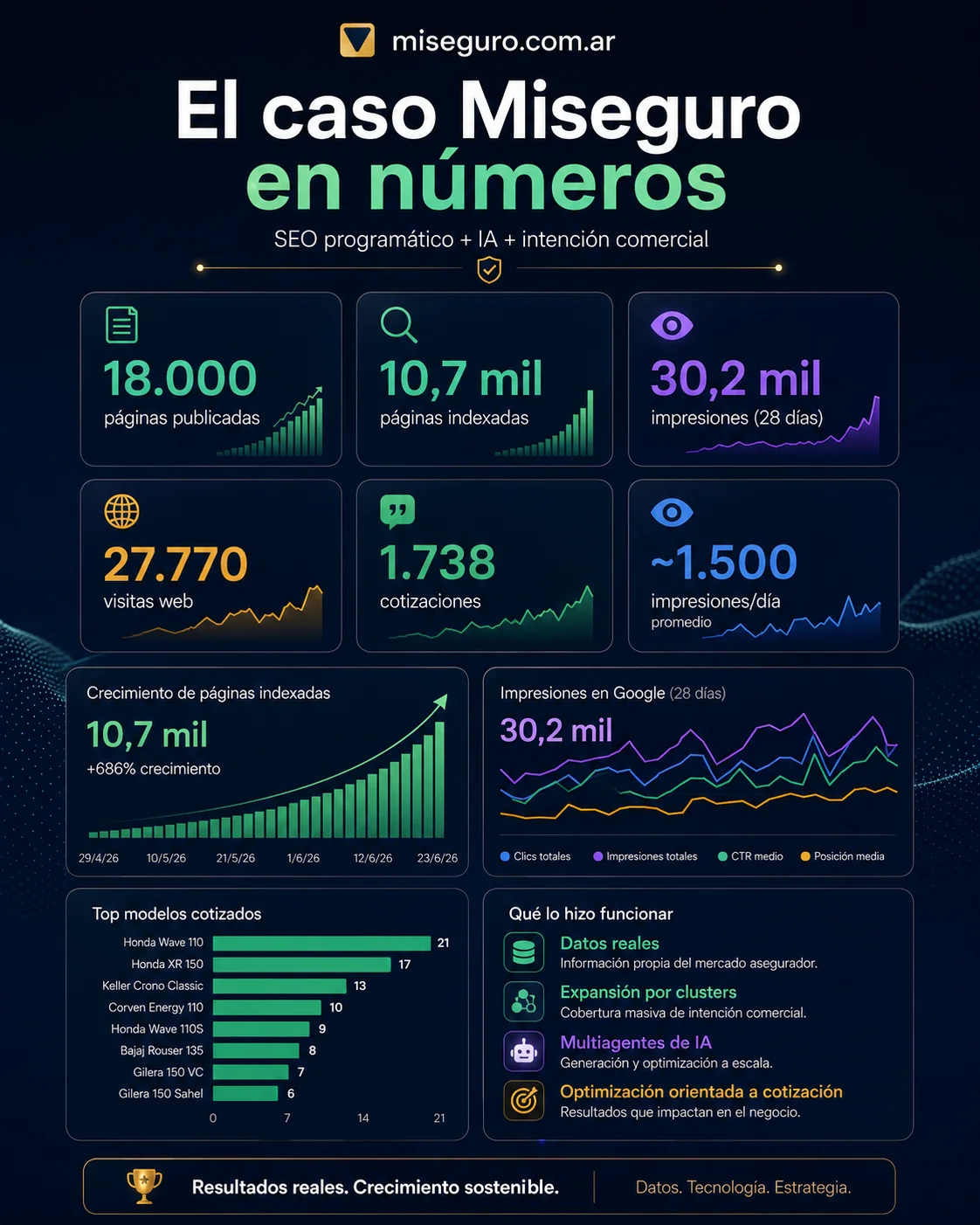

That changes everything. We’re no longer just talking about traffic or visibility. We’re talking about a concrete relationship between indexation → impressions → visits → quotes. And that’s what makes a real-world case compelling: it’s not just “Google showed some pages”, it’s “the system started generating real business.”
Published ≠ Indexed
One of the most overlooked truths in programmatic SEO: publishing thousands of pages doesn’t mean Google will index them. That gap needs to be acknowledged honestly.
In this case, around 18,000 pages were published, but only 10,700 are indexed. That means a significant portion has already been accepted into Google’s index, while another chunk is still being processed or hasn’t made it in yet, and that’s perfectly fine.
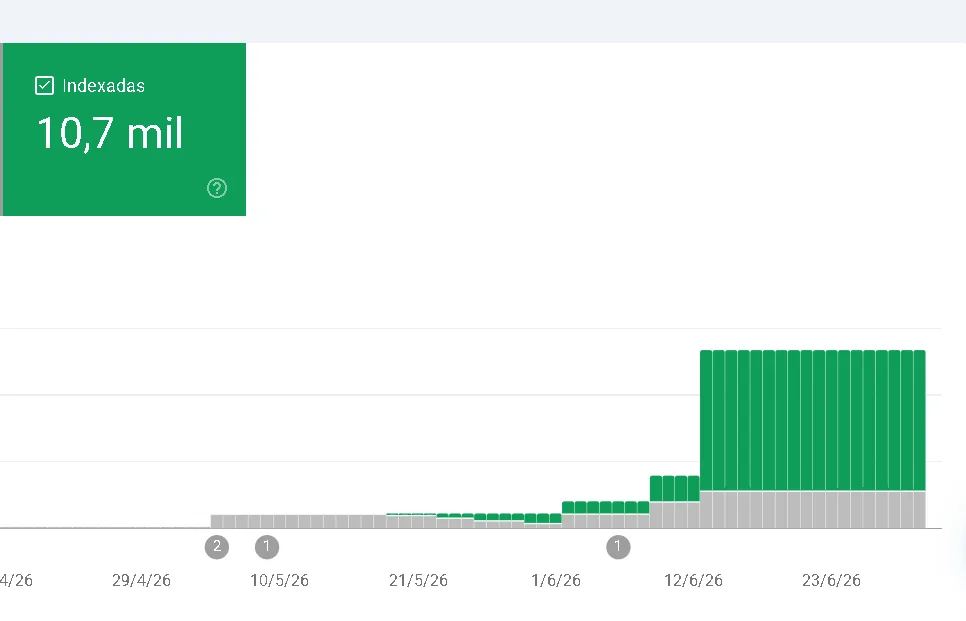
Because in a serious project, the useful metric isn’t just how many URLs were created. The real useful metrics are: how many were discovered, how many got indexed, how many receive impressions, how many capture clicks, how many drive visits, and how many lead to valuable actions. Measuring only “pages created” is a production metric. Measuring indexation, performance, and commercial impact? That’s a system metric.
The Winning Formula: Real Data, Not Fluff
A programmatic page can’t justify its existence just by swapping a city or model name. If the only thing changing is the template, the usefulness is low, and at scale, that hurts.
That’s why a key decision was making sure every page wasn’t just rehashed text, but pages with real substance behind them: built to answer a specific intent and deliver real value to the searcher.
AI helps, massively, but it’s not the secret sauce. The secret is how you use it: with judgment, over a solid foundation, not as a mass text-generation machine.
The Multi-Agent Pipeline: How AI Actually Works
One of the most powerful parts of the system is that it doesn’t rely on “one agent that writes pages.” We built a broader logic where AI participates across multiple layers of the process.
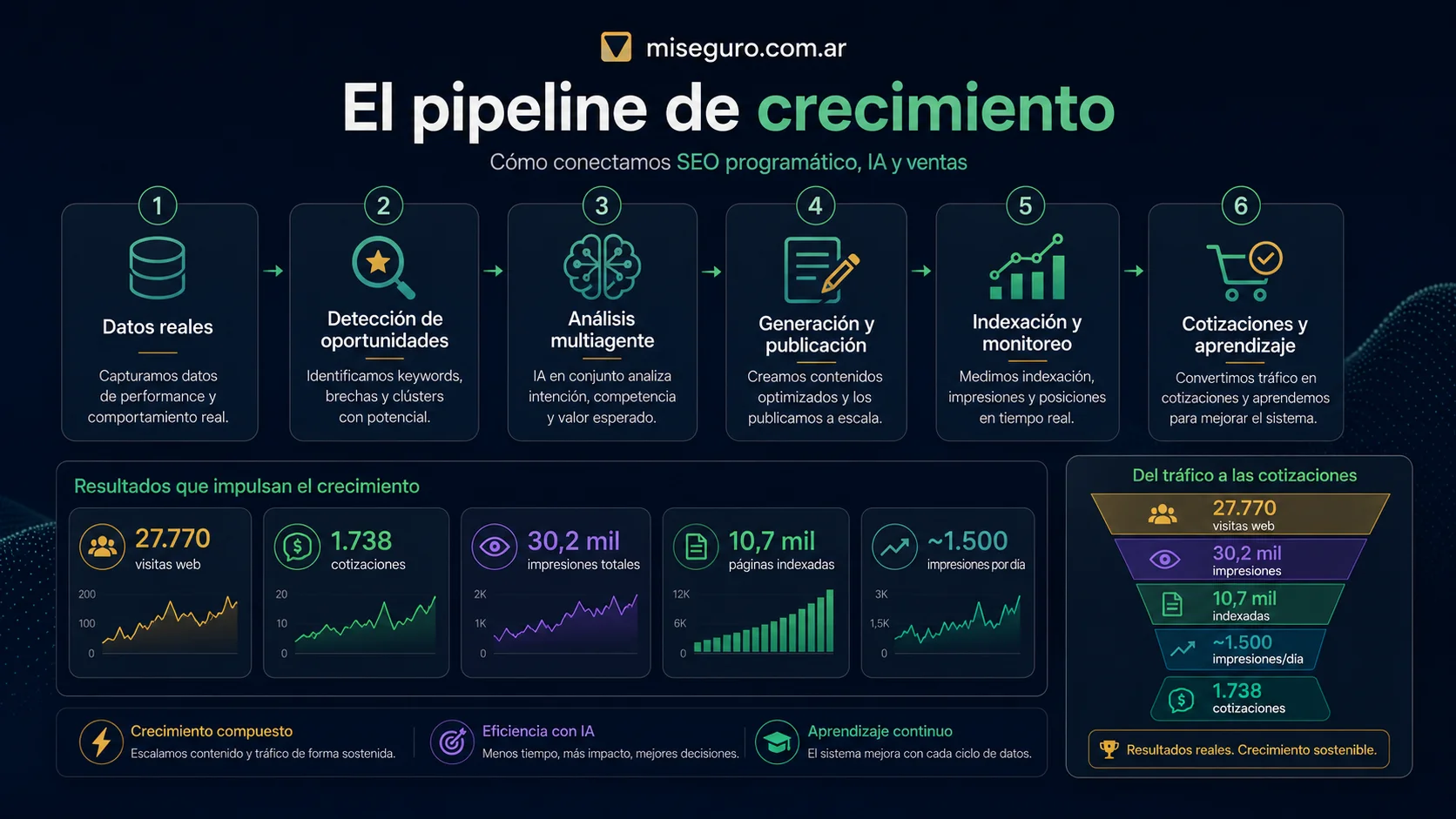
1. Opportunity Discovery
The system analyzes signals to detect where expansion makes sense: search clusters, content gaps, uncovered combinations, opportunities with commercial intent, and growth by URL families. We’re not asking the model for ideas, we’re giving it real context so it can help us make better decisions.
2. Intent Analysis
Not all searches are at the same stage. There are informational, comparative, transactional, local, price-oriented, issuance-ready, or quote-near queries. Separating these completely changes the kind of landing page you should build.
3. Prioritization
This is where a key part of the system kicks in: a proprietary scoring and evaluation logic. We won’t share the exact formula or methodology, because that’s where much of the service’s value lies. But we will say that we don’t prioritize by raw volume. Instead, we combine signals like intent clarity, ability to differentiate the page, commercial potential, cluster context, indexation opportunity, and expected value.
4. Generation & Publishing
Once combinations are prioritized, the system generates and assembles pages optimized to answer a specific intent, and publishes them at scale.
5. Monitoring & Indexation
Then comes a critical stage: measurement. Which pages get indexed? Which don’t? Which start showing impressions? Which climb in rankings? Which stall? Which need improvements?
6. Learning
The system doesn’t stop once it publishes: it learns from the outcome. Then it decides where to expand, what to improve, what to consolidate, and what to stop multiplying. That turns programmatic SEO from a one-time content dump into a living discipline.
Why Commercial Focus Changes Everything
A big part of miseguro.com.ar’s value is that growth isn’t measured just by visibility, it’s measured by business impact. That forces us to think about SEO differently: ranking isn’t enough.
There has to be a clear connection between search intent, page type, value proposition, user experience, and the real possibility of generating a quote. That’s why the project wasn’t built as “SEO content” over here and “product” over there. The organic page is part of the commercial journey: it starts with a search, but it doesn’t end there. It ends when the site’s structure turns visibility into a useful action, in this case, quotes.
What These Results Tell Us
Today’s results don’t mean “mission accomplished.” They mean something more interesting: the system is working, and it still has plenty of room to grow.
An average position of 7, combined with growing impressions, suggests many pages are already seen as relevant by Google, but aren’t yet capturing their full traffic potential. That opens a clear second phase: improve CTR, tweak titles, strengthen initial answers, push pages near the top, consolidate clusters, and keep expanding where signals justify it. In other words, this case has moved past validation, it’s now in an acceleration phase.
What We Wouldn’t Do Again
A strategy like this falls apart fast if executed poorly. For example: publishing every possible combination without judgment, generating pages that only swap two variables, using AI to fill space without adding value, ignoring indexation tracking, dismissing commercial intent, overlooking cannibalization, disconnecting SEO from product, or continuing to expand clusters Google clearly isn’t rewarding.
Scale amplifies everything: it amplifies successes and multiplies mistakes. That’s why serious programmatic SEO needs way more than automation. It needs judgment.
So… What Is Programmatic SEO Really?
To us, it’s not “publishing lots of landing pages.” It’s building a growth architecture based on meaningful combinations, data that justifies every URL, useful content, prioritization logic, controlled automation, constant measurement, and a direct link to business outcomes.
At miseguro.com.ar, that translated into a system that’s already showing real indexation, growing impressions, traffic, and quotes. AI plays a crucial role, but it’s not magic. There’s no magic. There’s data, technology, strategy, and execution.
Final Thoughts
The miseguro.com.ar case proves what often gets lost in conversations about AI and SEO: it’s not about generating content faster, it’s about building a better system. One that detects opportunities, publishes with judgment, learns from results, and turns visibility into real business.
Today, that system has 18,000 pages published, 10,700 indexed, 30,200 impressions in 28 days, 27,770 visits, and 1,738 quotes, and it’s still growing.
If your business operates in a space with natural, repeatable dimensions, localities, categories, products, models, specialties, or similar combinations, there’s likely a programmatic SEO opportunity there. The key isn’t treating it like a content factory, but like a well-designed acquisition machine.
Ready to Do Programmatic SEO the Right Way?
At PairProgramming, we help companies build growth systems where SEO, data, AI, and product work together, not as separate silos. We don’t just churn out pages by volume. We design architectures that make technical, commercial, and operational sense.
We run all of this through our specialized agency, Programmatic SEO & GEO. If you want to explore whether your business has a real programmatic SEO opportunity, reach out to us.
By Esteban Aleart, Founder & Lead Engineer at PairProgramming.
FAQ
How many pages on miseguro.com.ar are actually indexed?
Around 10,700 pages indexed out of roughly 18,000 published. Publishing isn’t the same as indexing, what matters isn’t how many URLs you create, but how many Google discovers, accepts into its index, and ultimately surfaces in search results.
Is programmatic SEO just about generating tons of pages?
No. 18,000 pages aren’t 18,000 opportunities. Without real data, commercial intent, and smart prioritization, volume creates duplicate intent, thin content, and poor indexing. The key is publishing with judgment, not creating everything possible.
What role does AI actually play in this system?
AI is embedded across multiple layers: discovering opportunities, analyzing search intent, prioritizing combinations, generating optimized pages, monitoring indexation, and learning from performance. But the real value isn’t AI itself, it’s using AI *on top of* data, intent, structure, and measurement.
Can these results be replicated in other industries?
Yes, if your business has natural, repeatable dimensions like locations, categories, products, models, or services with commercial intent. Insurance is ideal, but the same approach works for any vertical where searches can be logically combined and targeted.
Related articles
ModoJuego ahora es partner de Instant Gaming: cómo integramos afiliados en un portal de 5.000 juegos
ModoJuego, el portal de videojuegos que armamos con SEO programático, se sumó al programa de partners de Instant Gaming. Qué cambia para quien lo visita y cómo lo integramos en más de 4.000 fichas sin tocar el SEO ni la aprobación de AdSense.
IAMCP: When Chat Goes Beyond Just Text (and What We Did with It at PairProgramming)
People no longer start on Google; they begin by asking an AI. We set up our own MCP server to be part of that conversation: scoping projects, generating leads, and displaying an embedded form within the chat. What MCP is, what MCP Apps are, and why it matters.
AutomatizaciónHow to Integrate a Telegram Bot (The Free Alternative to WhatsApp That Almost Nobody Takes Advantage Of)
WhatsApp dominates in LATAM, but it charges you per message and sets rules. Telegram is free, integrates in five minutes, and is the primary channel in many parts of the world. Here's when each one is convenient.