Tontin-BETe Called This Final Back in May. It Simulated It 50,000 Times
Before a ball was kicked, the model said the most likely final was Spain–Argentina, a coin flip. This Sunday, that final is being played. We simulated it 50,000 times, and it's still a coin flip.
July 16, 2026
On May 28, before a ball was kicked, we published Tontin-BETe's predictions for the World Cup: 20,000 simulated tournaments, Spain first (~13%), Argentina second (~11%), when the market had them fifth or sixth, and a line that reads differently today: "the most likely final is Spain–Argentina, and it's a coin flip."
This Sunday, it's Spain–Argentina.
The model didn't guess a scoreline: it called the exact final matchup a month and a half out. So we did the only thing that made sense: simulate the final. This time, fifty thousand times.
The Numbers of the Final
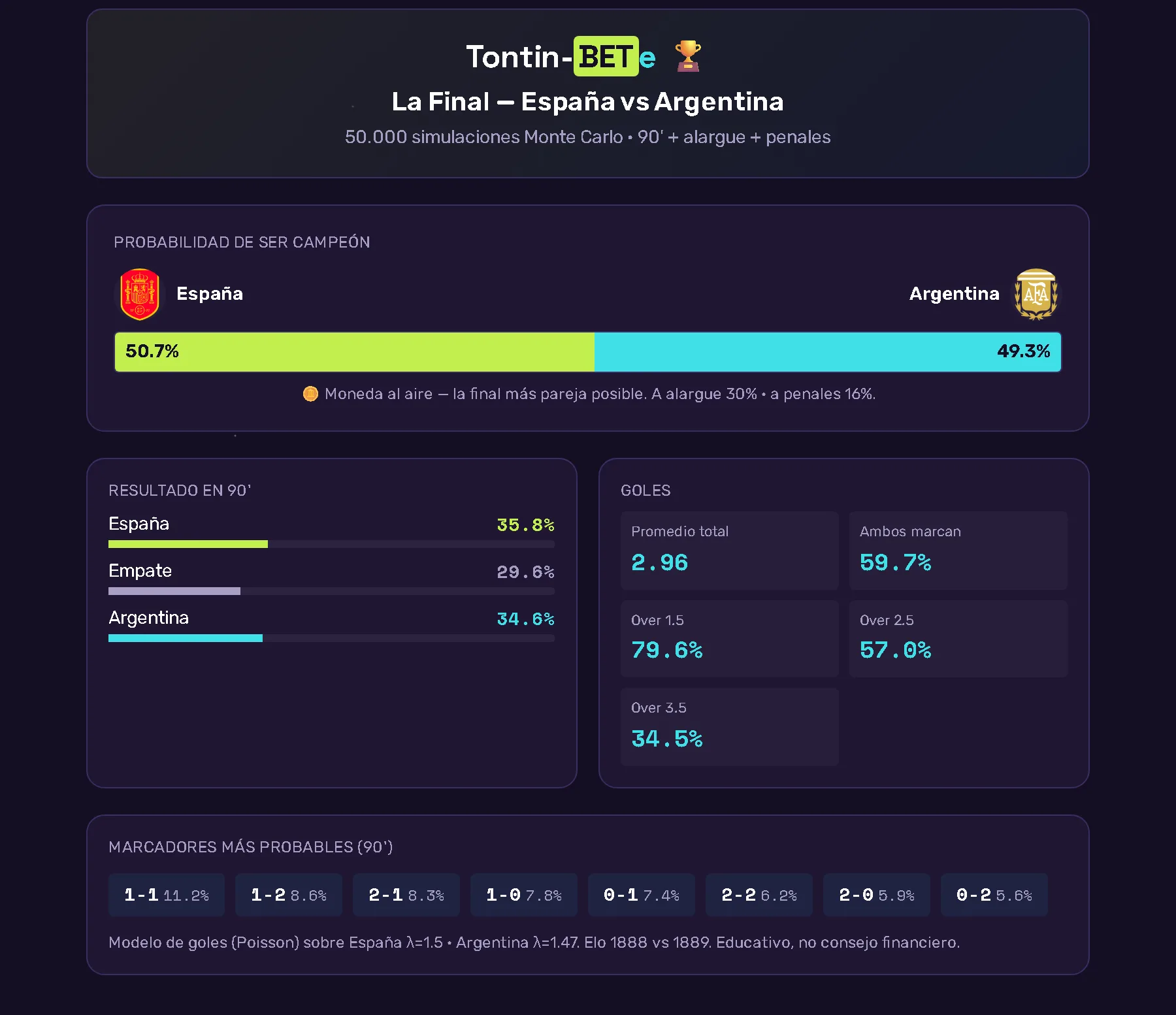
- Champion: Spain 50.7% vs Argentina 49.3%. A point and a half apart, with nearly identical Elo (1888 vs 1889). There's no real favorite: a single detail decides it.
- In 90 minutes: Spain 35.8% · draw 29.6% · Argentina 34.6%. Almost three in ten finals end level in regulation: 29.6% go to extra time and 15.8% reach penalties.
- Goals: an average of 2.96 per simulated final. Both teams score in 59.7% of cases and Over 2.5 runs at 57%. A dull 0-0 is not projected.
- The most likely scoreline is 1-1 (11.2%), exactly the one that pushes the final to extra time. Next come 1-2 (8.6%), 2-1 (8.3%) and 1-0 (7.8%).
Personal Disclaimer, Part Two
Back in May I wrote that I hated the result and that I hadn't touched a single number. I stand by both. The model gives Spain a point-and-a-half edge: if I correct it so Argentina wins, it stops being a model and becomes a wish. 🇦🇷
The Thesis: the Model Backs Argentina More Than the Market Does
The market prices the final like this: Spain 41.4% · draw 31.3% · Argentina 27.3% (implied probabilities). Our model gives Argentina 34.6%, seven points above the market (ten, if you look at the raw Poisson, without the draw adjustment).
It's not an error to fix: it's the thesis of the whole tournament. Tontin-BETe deliberately doesn't copy the market, and its divergences are measured against results, not against odds. May's theses, so far: the final, called and nailed. France in the final rounds, delivered: it reached the semis. Morocco champion, no, though it did make the final eight. The only open thesis closes on Sunday.
And yes: I'm Argentine, and the model's most pro-Argentina number is exactly the one I like most. That's why it's the one we audit the most, not the one we celebrate the most. It was published before the match, dated: the pitch delivers the verdict.
Fifty Thousand Simulations, a Different AI, the Same Numbers
Before publishing, we asked Claude (Fable, by Anthropic) to reimplement the engine from scratch: its own code, its own seed, plus the exact analytical calculation of the distribution. It ran its 50,000 finals and nailed the same numbers, with deviations of ±0.3 to ±0.5 points, exactly the statistical noise you'd expect between two independent Monte Carlo runs.
That doesn't validate the thesis (the pitch does that on Sunday): it validates the implementation. There's no bug. The numbers are what they are.
The original prediction: it all started on May 28, with the tournament yet to begin. The model played the entire World Cup 20,000 times, put Spain first, Argentina second, and called this final a coin flip. The full story is here 👉 Tontin-BETe Simulated the 2026 World Cup 20,000 Times: Here's What the Math Says.
Method note: proprietary Elo on a neutral field, a Poisson goals model (λ Spain 1.5 · Argentina 1.47), 50,000 simulations with extra time and penalties. The 1X2 carries the structural draw adjustment ("empate_modal"): reviewing 39 matches already played in the tournament, 8 of 13 errors from the raw model were draws it didn't see coming. The champion probability is robust to the adjustment; the goal distribution is the raw Poisson. This is a statistical simulation for educational purposes, not financial advice: the coin can land either way. By Esteban Aleart, Founder & Lead Engineer at PairProgramming.
FAQ
What are Argentina's chances of winning the 2026 World Cup final?
According to Tontin-BETe, Argentina is champion in 49.3% of the 50,000 simulations (Spain, 50.7%). In 90 minutes: 34.6% Argentine win, 29.6% draw and 35.8% Spanish win. It's the closest final the model can produce.
Did the model get the 2026 World Cup final right?
It got the matchup right: on May 28, before the tournament, it published that the most likely final was Spain–Argentina, and that's the one being played. The champion is decided on Sunday; the prediction (50.7% vs 49.3%) was published before the match.
Why does it differ from the bookmakers?
Because it doesn't copy the market: it starts from its own Elo and goals model, and deliberately disagrees when the numbers justify it. Today it gives Argentina seven points more than the odds. That divergence isn't corrected: it's measured against the real result, and that feeds its memory.
How was the simulation validated?
With an independent reimplementation: Claude (Fable, by Anthropic) rewrote the engine with different code and a different seed, added the exact analytical calculation, and ran its own 50,000 simulations. The results matched within Monte Carlo noise (±0.3 to ±0.5 percentage points).
Related articles
Programmatic SEO in Production: How We Scaled multicotizadorseguros.com with AI, Data, and Architecture
A real-world case study of a site that went from initial validation to thousands of pages, 18,000 published, 10,700 indexed, delivering over 30,200 impressions, 373 clicks, a 1.2% CTR, and 1,738 quotes in just 28 days.
IAMCP: When Chat Goes Beyond Just Text (and What We Did with It at PairProgramming)
People no longer start on Google; they begin by asking an AI. We set up our own MCP server to be part of that conversation: scoping projects, generating leads, and displaying an embedded form within the chat. What MCP is, what MCP Apps are, and why it matters.
AutomatizaciónHow to Integrate a Telegram Bot (The Free Alternative to WhatsApp That Almost Nobody Takes Advantage Of)
WhatsApp dominates in LATAM, but it charges you per message and sets rules. Telegram is free, integrates in five minutes, and is the primary channel in many parts of the world. Here's when each one is convenient.